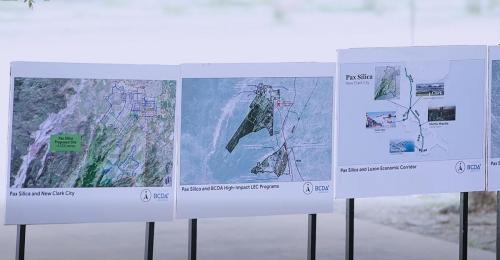
The plans for the proposed Pax Silica site in New Clark City can be seen at the unveiling of the ceremonial marker of the site attended by US Under Secretary Jacob Helberg, who leads the US-led international initiative, at New Clark City, Tarlac on May 20, 2026. Screenshot from The BCDA Group video
Business leaders and diplomats are urging the Marcos administration to slash red tape and ensure policy predictability to unlock massive capital inflows into the Luzon Economic Corridor (LEC).
In a news release on Tuesday, Stratbase Institute said the call took center stage during its 11th Pilipinas Conference, wherein corporate leaders and foreign envoys cautioned that multi-billion-dollar investment pledges risk stalling without aggressive government intervention.
Conceptualized in 2024 by the Philippines, the United States, and Japan, the LEC aims to connect key economic engines across Subic Bay, Clark, Metro Manila, and Batangas through rail, clean energy, and logistics links.
In particular, Stratbase said US Ambassador Lee Lipton said that international backing has expanded significantly, yet executing projects remains the critical bottleneck.
Lipton added that while Washington committed to Subic shipyard upgrades and a $60-million governance grant, government agencies must streamline approvals.
Likewise, representatives from Japan, the European Union, France, and Spain also urged state regulators to establish single-window applications and concrete permitting timelines to assure incoming capital, according to Stratbase.
Local business chambers also said that domestic bottlenecks could severely hurt the initiative, according to the think tank.
Stratbase said Makati Business Club chairman Edgar Chua said foreign investors require long-term policy consistency, stressing that government contracts must remain "sacred."
To solve coordination friction, Management Association of the Philippines president Donald Lim proposed establishing an independent public-private oversight body to manage implementation, adding that the country must not miss this chance to leapfrog into high-value manufacturing, the think tank noted.
Danilo Lachica, president of the Semiconductor and Electronics Industries in the Philippines, likewise, said that local power tariffs of $0.18 to $0.19 per kilowatt-hour far exceed the regional $0.07 benchmark required to draw advanced chip manufacturing.
Stratbase said that Roberto Locsin, president of Manila Water, also affirmed that water suppliers can supply high-tech facilities through circular water recycling systems, but warned that power and water security remain the basic foundations of any successful economic zone.
Moreover, Chamber of Mines chairman Mike Toledo urged authorities to roll out an aggressive information campaign on the corridor and the Pax Silica initiative to eliminate public misconceptions and safeguard economic sovereignty, according to the think tank.