


China laying groundwork for Scarborough Shoal takeover, possible Batanes claim — ex-US officer
September 01, 2026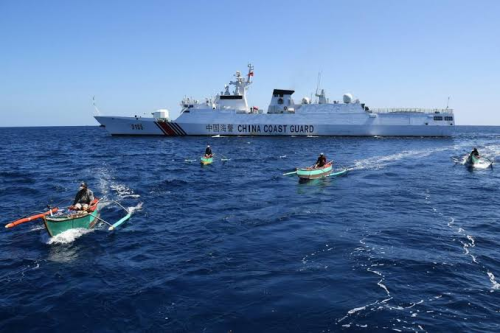
China could seek to occupy Scarborough Shoal by the end of the decade after laying political, economic and legal groundwork for possible coercive action in the disputed South China Sea, a retired US Navy intelligence officer warned Saturday.
Capt. Carl Schuster, a former director of operations at the US Pacific Command Joint Intelligence Center near Pearl Harbor, said China’s growing military, coast guard and maritime militia presence around the shoal suggests Beijing views the feature as the “final link” in its expanding network of positions across the South China Sea.
Speaking at an online forum organized by the National Youth Movement for the West Philippine Sea (NYMWPS), Schuster said he does not expect China to immediately launch a military operation to seize Scarborough Shoal, but warned that Beijing could instead employ coercive tactics to pressure the Philippines into allowing Chinese construction in the area.
“Scarborough Shoal is the final link in the chain in South China Sea. I don't think they're going to do something right away, but I do think it may be a problem by the end of this decade," Schuster said.
He said he has not seen "conclusive evidence" of construction at Scarborough, which the Philippines calls Bajo de Masinloc and Panatag Shoal but "would not be surprised to discover they are at least considering it."
Rather than an outright military takeover, Schuster said Beijing could initially employ so-called gray-zone tactics to force Manila to submit to Chinese construction or other activities around the shoal.
He said China's expanding surveillance network, including radar systems, aircraft, Coast Guard vessels and maritime militia boats, could eventually give Beijing a significant advantage in monitoring activity across the South China Sea.
“It's very clear that China hopes to maintain a surveillance advantage over the South China Sea so that should they decide to control it, they can," he said.
Australian defense professor Carl Thayer, who joined the forum, said satellite imagery has likewise shown a rapid increase in Chinese Coast Guard and maritime militia activity around Scarborough Shoal and adjacent features.
Thayer described the developments as “very worrying,” noting what he said was a doubling or quadrupling of Chinese Coast Guard and maritime militia presence in the area.
"Various think tanks and groups that use satellite imagery have honed in on the massive and rapid Chinese presence and activity around Scarborough Shoal and some of the adjacent features... By doubling and quadrupling the presence of the Coast Guard, maritime militia," Thayer said.
"Last year, September, I think, [China is] declaring it a kind of marine protected area, which was to advance," he added.
Schuster said China typically does not rely solely on military force when advancing its territorial interests.
Instead, he said Beijing spends years shaping the political, economic and legal environment before resorting to coercive measures.
He said this approach makes it necessary for the Philippines and other Southeast Asian countries to respond not only through defense capabilities but also through diplomacy, economic cooperation, legal action and information campaigns.
Schuster urged the Philippines to immediately publicize evidence of Chinese activities and lodge diplomatic protests, arguing that controlling the narrative could help constrain Beijing's actions.
“Get the evidence that they did something. If you've crafted the language in advance so that you can get it released quickly, then your narrative hits the global audience before theirs. Since they have the initiative, they may have the narrative prepared in advance," Schuster said.
Schuster also raised a separate concern over a recent scholarly study from Beijing University that reportedly claimed the Batanes island group was historically part of China.
He stressed that the study does not constitute an immediate threat to Philippine sovereignty over Batanes. But he said China's failure to publicly reject the study was noteworthy because, in his assessment, similar scholarly works have preceded territorial claims elsewhere.
“Beijing typically doesn't make an official claim until its military or gray zone forces are capable of initiating a pressure campaign," he said.
Schuster said he does not expect a formal Chinese claim over Batanes soon, estimating that such a move could emerge toward the end of the decade or possibly in the 2030s.
He argued that preventing China from gaining control of Scarborough Shoal could consequently help deter a future move against Batanes.
"But they'll occupy Scarborough Shoal first if they can get away with it. And so, in many ways, preventing the occupation of Scarborough Shoals prevents or deters the possibility of them going after Batanes," Schuster added.
The retired intelligence officer also backed the Philippines' efforts to strengthen its military capabilities, particularly through the acquisition of conventional submarines.
He argued that submarines would be particularly useful in the South China Sea because of its shallow waters, allowing smaller conventional submarines to operate in areas where larger nuclear-powered submarines may face limitations.
Schuster also that the Philippines should also continue strengthening its partnerships with other countries while avoiding an approach that relies exclusively on the United States.
The discussion also touched on Indonesia's efforts to expand its maritime and air defense capabilities while maintaining relationships with both Washington and Beijing.
Schuster said ASEAN countries should deepen security cooperation while maintaining diplomatic and economic engagement with China, which has developed extensive economic and political relationships across Southeast Asia.
"So presence, deterrence, diplomacy, economic, security, and political cooperation, and legal cooperation... that has to be done. And if it's done to a growing extent, then I think that will deter China from doing anything overly aggressive," he said.