Can a story stay unmistakably Filipino and still resonate with the rest of the world? That question sat at the center of the Philippine launch of Culturally Intelligent Storytelling for Southeast Asian Creators, held July 23, 2026, at The Loft, Areté, Ateneo de Manila University, organized and presented by the Rizal Library in cooperation with Areté.
Rather than a straightforward book event, the gathering unfolded as a working conversation among media practitioners, educators, and creative professionals on what it actually takes for Filipino storytelling to reach global audiences without losing its footing at home.
A Library, Not a Bookstore, Set the Stage
The launch had an unusual origin. Author Ned Legaspi joined Ateneo de Manila University's Department of Communication in January 2026 as a part-time faculty member teaching Writing for Film, at the encouragement of Department Chair Dr. Christine Cox, who saw value in introducing the book's CIS Bamboo Framework to students writing for the screen.
What began as a simple donation of book copies to the Rizal Library evolved into something bigger once librarians Edz Santos and Mark James G. Cayabyab, and later University Librarian Joenabie E. Arevalo, recognized the opportunity to formally organize a Philippine launch around it. The result placed the Rizal Library, not a bookstore or media outlet, as the institutional host, and made it the first Philippine library to hold copies of the book as part of a donation initiative Legaspi hopes to expand to other schools.
A Talk Show Built Around a Story's Journey
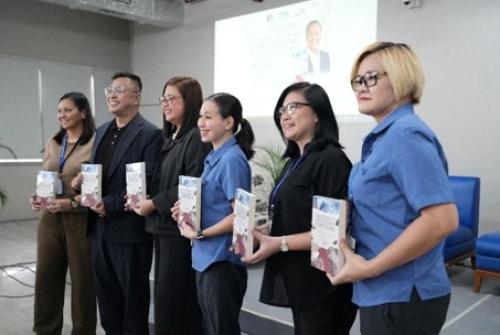
BOOK DONATION. Author Ned Legaspi (second from left) formally hands over copies of his book to Rizal Library representatives during a turnover ceremony.
Rather than deliver a lecture on his own book, Legaspi designed the program as a talk show style conversation, where each speaker stood in for a different stage of a story's journey, from the industry conditions that shape whether it can travel, to the internal choices that shape who is telling it. His own role came last, to listen, connect the threads, and explain what the book adds to a conversation already bigger than any single author.
Industry Voices on Going Global
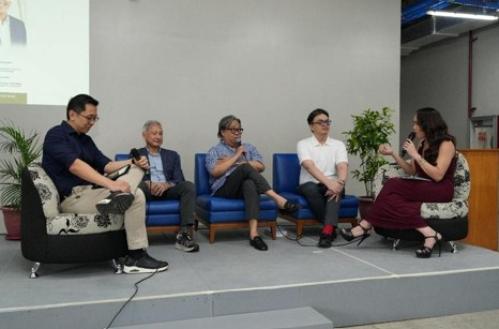
INSIGHTFUL DISCUSSIONS. (L–R) Host Galvin Ngo, ABS-CBN’s Mark Nepomuceno, Direk Ruel S. Bayani, GMA Head Writer Ken de Leon, and host Jervi Wrightson (Kaladkaren) engage in a panel discussion during the event.
The program's first panel tackled the external conditions Filipino stories face when they leave home. Media executive Mark Nepomuceno argued that international expansion is not just a cultural aspiration but a commercial necessity for sustainable growth. Director Ruel S. Bayani pushed back on the idea that spectacle is what travels, pointing instead to cultural specificity paired with emotional clarity as the real passport for a story crossing borders. Writer-producer Ken de Leon added that today's streaming and co-production landscape has made cultural intelligence a practical skill for creators negotiating with international partners, not just a philosophical stance.
The Internal Question: What Kind of Storyteller Are You Becoming?
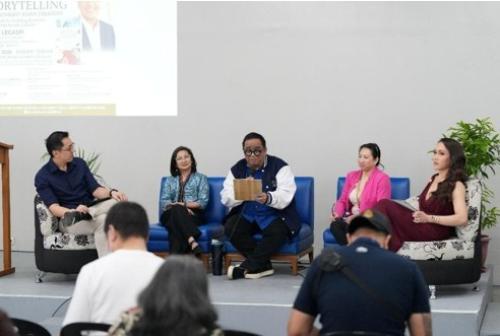
ACADEMIC AND INDUSTRY PERSPECTIVES. (L–R) Galvin Ngo, Dr. Gina Hechanova-Alampay, Noel Ferrer, Dr. Christiane Cos, and Jervi Wrightson share insights during the panel session.
The second panel turned the lens inward. Writer and talent manager Noel Ferrer offered a memorable frame: creators do not need to translate their culture to make it palatable abroad. They need to show why it matters to the people inside the story. Dr. Christine Cox extended the point to identity, arguing that global relevance is not about imitating international models but about writing from a clear, grounded standpoint. Psychologist Dr. Regina Hechanova-Alampay closed the panel with a social science lens, noting that research explains people, but stories are what make audiences feel that understanding, which is ultimately how hearts change.
Co-hosts Galvin Radley Ngo of Ateneo SALT and broadcaster Jervi Wrightson (KaladKaren) guided the exchange, bridging the academic and entertainment perspectives in the room.
Where the Framework Comes In
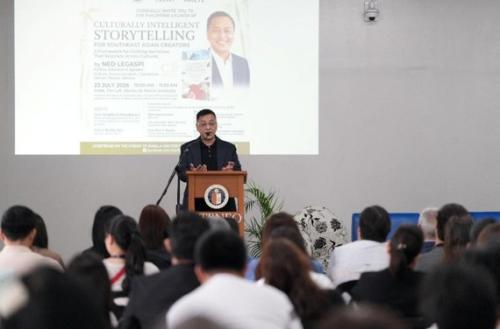
SYNTHESIZING PERSPECTIVES. Author Ned Legaspi addresses the audience to summarize key insights from the panel discussion and share the inspiration behind his book, Culturally Intelligent Storytelling for Southeast Asian Creators.
Legaspi closed the program by connecting the panel discussions to the CIS Bamboo Framework at the core of his book, organized around four questions: what grounds a story culturally, how that culture shapes its craft, how the story moves through industries and platforms, and what it ultimately leaves behind once it reaches an audience.
His point throughout was that going global is not a formula to master but a set of questions to keep asking, about what a story preserves, what it explains, and what relationship it builds between its culture of origin and the audience receiving it.
The Bigger Picture
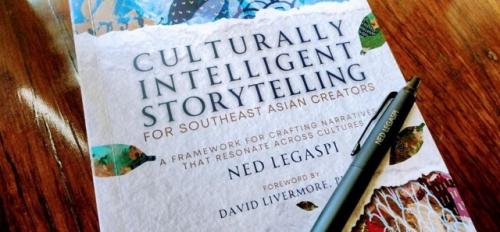
FEATURED WORK. Ned Legaspi’s “Culturally Intelligent Storytelling for Southeast Asian Creators” is available in the Philippines through Fully Booked and online marketplaces.
The Philippine launch is the third stop in the book's international rollout, following earlier launches in Santa Monica and San Francisco. Culturally Intelligent Storytelling for Southeast Asian Creators, published under BrightGlobe Books, is available in the Philippines through Fully Booked and online marketplaces, with Simplicitive Ventures, Inc. as its official Philippine distributor.


.png)


.png)

.png)
 copy.jpg)