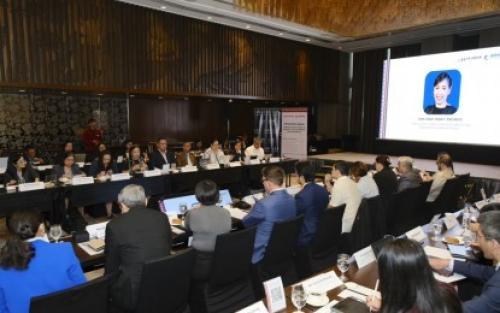
MANILA – Two leading United States and Southeast Asian business groups are pushing to advance the supply chain resilience agenda under the Philippines’ chairship of the 2026 Association of Southeast Asian Nations (ASEAN).
At a high-level roundtable gathering of senior officials and industry leaders on Wednesday, the US-ASEAN Business Council (USABC) and the ASEAN Business Advisory Council Philippines (ASEAN-BAC Philippines) highlighted the mounting pressures on Southeast Asian supply chains arising from geopolitical tensions, climate disruptions and structural inefficiencies in trade and logistics systems.
“ASEAN’s supply chains are being tested by a convergence of external shocks and structural constraints. Like the COVID-19 pandemic, current geopolitical tensions underscore how quickly disruptions can ripple across trade, energy, and logistics systems,” USABC Philippine Chief Representative Herminio Bagro said.
Bagro said as a leading investors group in the region, USABC wants to see practical solutions, greater policy transparency, stronger public-private coordination and more efficient customs systems elevated by ASEAN this year.
During the discussions, illicit trade emerged as a key concern, with business leaders noting that fragmented enforcement regimes and uneven regulatory capacity continue to enable the proliferation of counterfeit and smuggled goods.
Among the recommendations outlined were regulatory guidance to reduce uncertainty for investors and operators, and deeper public-private coordination to mitigate energy price volatility and supply chain disruptions.
Also pushed were streamlined customs, logistics and regulatory approvals to improve efficiency and reduce trade frictions; and the removal of unnecessary cross-border bans to ease regional supply chains.
“Supply chain resilience and sustainability are central to ASEAN’s long-term competitiveness,” ASEAN-BAC Philippines senior adviser Gil Gonzales said.
“This roundtable reflects our commitment to ensuring that private sector solutions are translated into concrete chairship deliverables that strengthen regional integration and economic stability,” he added.
The roundtable is the third of its kind, following the convening of USABC and ASEAN-BAC dialogues centered on health care, and sustainability and food security.
The USABC and ASEAN-BAC Philippines said these meetings will shape a coherent private sector agenda designed to support the Philippines’ 2026 ASEAN chairship.
At a separate forum on Thursday, Foreign Affairs Secretary Ma. Theresa Lazaro said the Philippines is committed to driving an ambitious ASEAN economic agenda to secure policies that will assist the bloc achieve its goal of becoming the fourth largest economy despite global economic shocks affecting the region.
"Resilience is not just about weathering the storm; it is about building the capacity to thrive within it. It is about being agile enough to pivot when traditional markets close, and bold enough to innovate when the status quo is dampened," she said.